Supreme Court Term 2025-2026
We’re breaking down the cases we've asked the court to consider this term.

Latest Case Updates
Ongoing
Updated November 3, 2026
Updated September 10, 2026
Ongoing
Updated September 8, 2026
Closed
Updated August 31, 2026
Featured
Ohio
Nov 2026

Reproductive Freedom
Planned Parenthood Southwest Ohio Region et al., v. Ohio Department of Health, et al.
The American Civil Liberties Union, the ACLU of Ohio, Planned Parenthood Federation of America, the law firm WilmerHale, and Fanon Rucker of the Cochran Law Firm, on behalf of Planned Parenthood Southwest Ohio Region, Planned Parenthood of Greater Ohio, Preterm-Cleveland, Women’s Med Group Professional Corporation, Dr. Sharon Liner, and Julia Quinn, MSN, BSN, amended a complaint in an existing lawsuit against a ban on telehealth medication abortion services to bring new claims under the Ohio Reproductive Freedom Amendment, including additional challenges to other laws in Ohio that restrict access to medication abortion in the state.
Alaska
Oct 2026
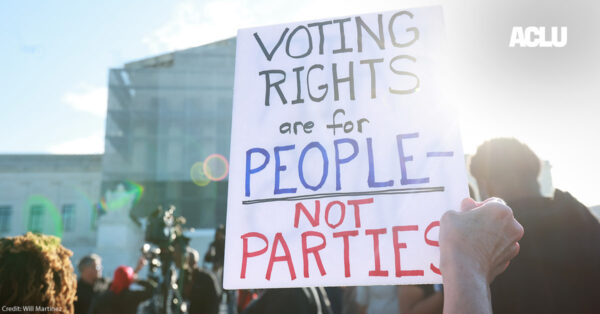
Voting Rights
United States v. Alaska
Representing two Alaska voters, the League of Women Voters of Alaska, and Common Cause, the American Civil Liberties Union and ACLU of Alaska moved to intervene in United States v. Alaska, a frivolous lawsuit seeking to prevent from the State of Alaska from certifying its election results if the incumbent U.S. Senator does not win the election. The lawless suit asserts a single claim based on the purpose language of the National Voter Registration Act (NVRA), that has no basis in any case, legal principle, or arguably tenable reading of the NVRA.
We are seeking dismissal of this suit that aims to deprive Alaskans of their right to vote and right to representation.
California
Oct 2026

Voting Rights
OCA-Asian Pacific American Advocates v. Department of Homeland Security
The Department of Homeland Security and United States Citizenship and Immigration Services are subjecting thousands of naturalized American citizens to improper investigations questioning their voting eligibility, and they’re using outdated, faulty data and methods to do so. As a result, these citizens face increasing, unwarranted scrutiny from the federal government and, potentially, disenfranchisement. We’re challenging these unlawful actions and the unreliable data behind them to ensure no eligible voter is targeted or silenced because of them.
Court Case
Oct 2026
National Security
Human Rights
FOIA Case Seeking the Trump Administration’s Legal Justification for Deadly Boat Strikes
The Department of Justice’s Office of Legal Counsel (“OLC”) authored a legal opinion that reportedly claims to justify the Trump administration’s illegal lethal strikes on civilians in boats in the Caribbean Sea and eastern Pacific Ocean. Media reports indicate that, in addition to claiming that the strikes are lawful acts in an alleged “armed conflict” with unspecified drug cartels, the OLC opinion also purports to immunize personnel who authorized or took part in the strikes from future criminal prosecution. Because the public deserves to know how our government is justifying these illegal strikes, and why they think the people who carried them out should not be held accountable, the ACLU is seeking immediate release of the OLC legal opinion and related documents pursuant to the Freedom of Information Act.
Colorado Supreme Court
Oct 2026
Civil Liberties
Criminal Law Reform
Daves v. Mosley
Section 131 of the newly enacted Enhance Law Enforcement Integrity Act gives Coloradans a cause of action to seek damages or equitable relief when state or local police officers violate the Colorado Constitution. In 2022, Christopher Mosley sued Officer Brendan Daves for conducting a warrantless search of his car, which Daves argued was lawful under the federal protective sweep doctrine. After Mosley prevailed at trial and the court of appeals affirmed, Daves appealed to the Colorado Supreme Court. The ACLU’s State Supreme Court Initiative and the ACLU of Colorado filed an amicus brief agreeing with Mosley’s argument that Daves has misapprehended the federal doctrine whilst focusing on a separate point: the Court’s interpretation of Section 131 is not bound by federal law.
Florida
Oct 2026
National Security
+2 Issues
CAIR-Foundation, Inc and CAIR Florida, Inc. v. DeSantis et al.
The ACLU, the ACLU of Florida, the Southern Poverty Law Center, and their partners represent CAIR and CAIR-Florida in two federal lawsuits challenging Governor DeSantis’s unconstitutional and baseless designation of the nonprofits as “terrorist.” The lawsuits allege violations of CAIR and CAIR-Florida’s rights under the First Amendment and the due process clause of the Fourteenth Amendment.
Washington, D.C.
Oct 2026

Voting Rights
Common Cause v. U.S. Department of Justice
The U.S. Department of Justice has launched an unprecedented and unlawful effort to invade the privacy of millions of American voters and threaten their right to vote. It has demanded that every state and the District of Columbia turn over their entire voter database, including Social Security Numbers, political party affiliation, and voter participation history. And at least a dozen states have complied, submitting their voters’ information for federal review. But the Department of Justice has no authority to dictate when a voter registration should be cancelled, and we are suing to stop the federal government’s overreach and ensure that voters’ information remains secure and free from unlawful interference.
Massachusetts
Sep 2026

Voting Rights
League of Women Voters of Massachusetts v. Trump
On March 31, 2026, President Trump issued a sweeping Executive Order titled “Ensuring Citizen Verification and Integrity in Federal Elections,” seeking once again to seize control of election administration from Congress and the states. The Order directs federal agencies to compile lists of U.S. citizens and transmit them to states before every election, directs the U.S. Postal Service — an independent agency established by Congress — to create a list of “approved” mail voters, and instructs USPS to refuse to deliver ballots from voters not on that federally created list. If implemented, the Order would threaten the ability of millions of eligible citizens to cast their ballots, particularly military members, overseas citizens, the elderly, recently naturalized citizens, and voters with disabilities who rely on mail voting.
Oregon Supreme Court
Aug 2026
LGBTQ Rights
Prisoners' Rights
Zyst v. Miller
Following the Oregon Department of Corrections’ unconstitutional treatment of a transgender prisoner, a habeas court ordered her removal from segregated housing, an individualized gender-affirming care assessment, a psychiatric evaluation, and identification of an appropriate cellmate. However, the Oregon Court of Appeals reversed the psychiatric-evaluation and cellmate orders, finding them “too attenuated” to qualify as habeas relief. The ACLU’s State Supreme Court Initiative, alongside the ACLU of Oregon, joined an amicus brief by the law firm Sugerman Dahab arguing that habeas courts have broad discretion to remedy violations and resulting harms. The brief explains that the Court of Appeals’ “close connection” test unduly constricts habeas relief, and which should be construed to encompass not only the need to halt ongoing constitutional violations, but also the need to mitigate various harms that may arise from those violations.
All Cases
1,767 Court Cases

Louisiana
Dec 2023
Voting Rights
Robinson v. Landry
Robinson challenged the congressional map that Louisiana enacted after the 2020 Census. ACLU and partners represented Plaintiffs the Louisiana State Conference of the NAACP, Power Coalition for Equity and Justice, and several impacted voters, and argued that the enacted plan violated Section 2 of the Voting Rights Act. In June 2022, the district court found Louisiana’s congressional map unlawfully denied Black voters a second district in which Black voters had an equal opportunity to elect their candidates of choice. After appeals, the legislature passed a new map containing two majority Black districts in January 2024.
Explore case
Louisiana
Dec 2023
Voting Rights
Robinson v. Landry
Robinson challenged the congressional map that Louisiana enacted after the 2020 Census. ACLU and partners represented Plaintiffs the Louisiana State Conference of the NAACP, Power Coalition for Equity and Justice, and several impacted voters, and argued that the enacted plan violated Section 2 of the Voting Rights Act. In June 2022, the district court found Louisiana’s congressional map unlawfully denied Black voters a second district in which Black voters had an equal opportunity to elect their candidates of choice. After appeals, the legislature passed a new map containing two majority Black districts in January 2024.

Florida
Dec 2023
Voting Rights
Supporting Defendants in Unlawful Florida Prosecutions of Returning Citizens (Amicus)
Florida has arrested and prosecuted many returning citizens—persons with felony convictions who are no longer incarcerated—for registering and voting while ineligible. These prosecutions have occurred amid widespread confusion about voting rights restoration in Florida and have been initiated by an Office of Statewide Prosecutor (“OSP”) that has no authority to bring these criminal actions.
Explore case
Florida
Dec 2023
Voting Rights
Supporting Defendants in Unlawful Florida Prosecutions of Returning Citizens (Amicus)
Florida has arrested and prosecuted many returning citizens—persons with felony convictions who are no longer incarcerated—for registering and voting while ineligible. These prosecutions have occurred amid widespread confusion about voting rights restoration in Florida and have been initiated by an Office of Statewide Prosecutor (“OSP”) that has no authority to bring these criminal actions.
Kentucky
Dec 2023
Reproductive Freedom
Jane Doe, et al. v. Daniel Cameron, et al.
A Kentucky woman filed a lawsuit in Jefferson County Circuit Court challenging two of the Commonwealth’s abortion bans that collectively eliminate almost all access to abortion in the Commonwealth. The case details the severe harms that Jane Doe, who is approximately eight weeks pregnant, and a class of all pregnant Kentuckians seeking abortion are enduring because the government has denied her access to the care she needs.
Explore case
Kentucky
Dec 2023
Reproductive Freedom
Jane Doe, et al. v. Daniel Cameron, et al.
A Kentucky woman filed a lawsuit in Jefferson County Circuit Court challenging two of the Commonwealth’s abortion bans that collectively eliminate almost all access to abortion in the Commonwealth. The case details the severe harms that Jane Doe, who is approximately eight weeks pregnant, and a class of all pregnant Kentuckians seeking abortion are enduring because the government has denied her access to the care she needs.
Minnesota Supreme Court
Dec 2023
Criminal Law Reform
State v. Malecha
In this case, the Minnesota Supreme Court is considering the scope of a crucial doctrine that protects criminal defendants from being convicted based on evidence obtained in violation of their constitutional rights. Under both the U.S. and Minnesota Constitutions, courts apply an “exclusionary rule” that allows criminal defendants to seek the exclusion of evidence obtained in violation of their rights. For nearly 40 years, the U.S. Supreme Court has chipped away at the exclusionary rule by adopting and expanding the “good faith exception,” a doctrine providing that in some situations courts need not exclude evidence obtained in violation of the Constitution. In this case, officers acquired evidence after arresting someone based on a warrant that was listed as valid due to a recordkeeping error, but which in fact should have been recalled. In July 2023, together with other ACLU attorneys and partners, the State Supreme Court Initiative submitted an amicus brief to the Minnesota Supreme Court asking it to hold as a matter of state constitutional law that the exclusionary rule applies to this situation, and that the good-faith exception does not apply. In March 2024, the Court ruled in the ACLU’s favor, stating that the district court did not err in finding that the defendant’s arrest warrant had been quashed before her arrest and the good-faith exception did not apply.
Explore case
Minnesota Supreme Court
Dec 2023
Criminal Law Reform
State v. Malecha
In this case, the Minnesota Supreme Court is considering the scope of a crucial doctrine that protects criminal defendants from being convicted based on evidence obtained in violation of their constitutional rights. Under both the U.S. and Minnesota Constitutions, courts apply an “exclusionary rule” that allows criminal defendants to seek the exclusion of evidence obtained in violation of their rights. For nearly 40 years, the U.S. Supreme Court has chipped away at the exclusionary rule by adopting and expanding the “good faith exception,” a doctrine providing that in some situations courts need not exclude evidence obtained in violation of the Constitution. In this case, officers acquired evidence after arresting someone based on a warrant that was listed as valid due to a recordkeeping error, but which in fact should have been recalled. In July 2023, together with other ACLU attorneys and partners, the State Supreme Court Initiative submitted an amicus brief to the Minnesota Supreme Court asking it to hold as a matter of state constitutional law that the exclusionary rule applies to this situation, and that the good-faith exception does not apply. In March 2024, the Court ruled in the ACLU’s favor, stating that the district court did not err in finding that the defendant’s arrest warrant had been quashed before her arrest and the good-faith exception did not apply.
Massachusetts Supreme Court
Dec 2023
Capital Punishment
Graham v. Hampden Cnty. Dist. Att'y
Federal and state constitutional law requires prosecutors to inquire into and disclose misconduct by members of their prosecution teams. In Massachusetts, the Supreme Judicial Court has applied those principles, and others, in cases that have led to the mass exoneration of people convicted of drug crimes with the assistance of former state chemists who committed misconduct. In Graham, the ACLU and public defenders are asking the Massachusetts Supreme Judicial Court to apply those same principles to a situation where the U.S. Department of Justice has alleged a pattern or practice of misconduct by members of a police department—specifically, the Narcotics Bureau of the Springfield (MA) Police Department. The Springfield investigation was the DOJ’s sole pattern-or-practice investigation during the Trump Administration, but the DOJ has opened several such investigations during the Biden Administration. Graham appears to be the first state supreme court case in the country to consider whether DOJ pattern-or-practice findings can trigger duties under state law to investigate and disclose the misconduct alleged by the DOJ. In a major victory, the Massachusetts Supreme Judicial Court ruled in January 2024 that the Hampden County District Attorney’s Office violated its duties to disclose and inquire about exculpatory evidence of widespread misconduct by Springfield police.
Explore case
Massachusetts Supreme Court
Dec 2023
Capital Punishment
Graham v. Hampden Cnty. Dist. Att'y
Federal and state constitutional law requires prosecutors to inquire into and disclose misconduct by members of their prosecution teams. In Massachusetts, the Supreme Judicial Court has applied those principles, and others, in cases that have led to the mass exoneration of people convicted of drug crimes with the assistance of former state chemists who committed misconduct. In Graham, the ACLU and public defenders are asking the Massachusetts Supreme Judicial Court to apply those same principles to a situation where the U.S. Department of Justice has alleged a pattern or practice of misconduct by members of a police department—specifically, the Narcotics Bureau of the Springfield (MA) Police Department. The Springfield investigation was the DOJ’s sole pattern-or-practice investigation during the Trump Administration, but the DOJ has opened several such investigations during the Biden Administration. Graham appears to be the first state supreme court case in the country to consider whether DOJ pattern-or-practice findings can trigger duties under state law to investigate and disclose the misconduct alleged by the DOJ. In a major victory, the Massachusetts Supreme Judicial Court ruled in January 2024 that the Hampden County District Attorney’s Office violated its duties to disclose and inquire about exculpatory evidence of widespread misconduct by Springfield police.