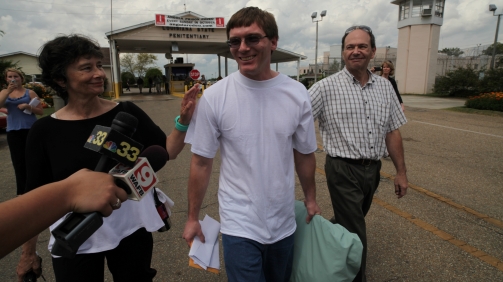

Watch the video here.
Damon's birthday and mine are two days apart, and for many years we would "celebrate" together while he was on death row. When I visit him this summer in Minneapolis to carry on our tradition, I expect we will have a MUCH better party.
For more on Damon Thibodeaux, click here. Since 1973, over 140 people have been released from death rows in 26 states because there were found to be innocent. The death penalty in the U.S. is applied largely based on how much money defendants have, the skill of their attorneys, the race of the victim, and where the crime took place. It's time to end this irreparably broken system.
Learn more about the death penalty and other civil liberty issues: Sign up for breaking news alerts, follow us on Twitter, and like us on Facebook.
Related Issues
Related Content
-
News & CommentaryJan 2026
Capital Punishment
Executions Spiked In 2025, But The Death Penalty Is Still Losing Ground. Explore News & Commentary.Executions Spiked in 2025, but the Death Penalty Is Still Losing Ground
As executions surged to their highest level in years, public support, jury verdicts, and new death sentences continued a historic decline—exposing a punishment sustained by political power, not public will. -
Press ReleaseDec 2025
Capital Punishment
Aclu Condemns Florida Supreme Court Decision Upholding Non-unanimous Capital Juries. Explore Press Release.ACLU Condemns Florida Supreme Court Decision Upholding Non-Unanimous Capital Juries
TALLAHASSEE – The Florida Supreme Court upheld Florida’s law allowing non-unanimous juries to sentence people to death upon a vote of 8-4, meaning a person can be sentenced to death in the state even if a third of the jury votes for life. The court’s decision came in a pair of cases, Jackson v. Florida and Hunt v. Florida, brought by two men sentenced to death by non-unanimous juries. The American Civil Liberties Union represents Mr. Michael Jackson, who was sentenced to death in 2007, despite 4 jurors voting for a life sentence. In 2016, the Florida Supreme Court declared non-unanimous sentencings unconstitutional after a Supreme Court decision ruled that Florida’s capital sentencing statute violated the Sixth Amendment. For years, Mr. Jackson waited to be re-sentenced under the law of unanimity, but weeks before his long-awaited retrial, the Florida legislature reinstated non-unanimous juries, and he was sentenced to death by another 8-4 jury. “Allowing a death sentence by a divided jury betrays the founders’ vision of the jury as a cornerstone of democracy and a protection against government overreach,” said Megan Byrne, senior staff attorney at the ACLU’s Capital Punishment Project. “Non-unanimous juries increase the risk of wrongful convictions and can operate to silence the voices of jurors of color. Florida’s high court has made clear that the state values speed and finality over accuracy and justice. We will be asking the Supreme Court to review this decision and reaffirm that the Constitution provides the right to a fair trial and a unanimous jury when life is at stake.” Florida is one of only two states to allow divided juries to sentence people to death and has the most extreme law in the country. As Justice Labarga of the Florida Supreme Court acknowledged in his separate opinion, “the 8-4 threshold renders Florida the absolute outlier among states that impose the death penalty. Florida now has the lowest standard in the nation, requiring the fewest number of jurors to recommend the death penalty.” Florida legislators enacted the non-unanimity law in 2023 despite a recent U.S. Supreme Court decision holding that unanimity is required for guilty verdicts in all cases where a defendant is charged with a serious offense. In that decision, the Supreme Court called out the racist origins of non-unanimity laws which states specifically designed to silence the voices of Black jurors. Non-unanimous sentencing schemes also heighten the risk of executing the innocent. Florida has had 30 exonerations from death row — the most capital exonerations of any state in the country. Of those, the vast majority (19) of exonerees were sentenced by non-unanimous juries. “More than 200 innocent people have been exonerated from death rows across America since 1976,” said Daniel Tilley, legal director of the ACLU of Florida. “Non-unanimous juries only amplify the risk that innocent people will be sentenced to death. Dissenting jurors often raise concerns about credibility, evidence, or mitigation, and non-unanimity allows someone to be sentenced to death despite unresolved doubt. When the stakes are life or death, we cannot afford to settle for anything less than what the Constitution promises.” Michael Hunt, the second man challenging non-unanimity, was arrested and charged with capital murder in 2018, when Florida law required the jury to be unanimous in any death recommendation. His trial was delayed until 2023, by which point the Florida legislature and courts had walked back the protection of unanimity. The jury convicted him unanimously, but voted only 10-2 for his death sentence. Had the jury issued this decision only six months earlier, Florida law would have required a life sentence. Read more about Mr. Jackson’s case here: https://www.aclu.org/cases/michael-jackson-v-state-of-florida -
News & CommentaryNov 2025

Criminal Law Reform
+2 Issues
Gary Tyler Spent 42 Years In Prison For A Crime He Didn't Commit. Racism Put Him There.. Explore News & Commentary.Gary Tyler Spent 42 Years in Prison for a Crime He Didn't Commit. Racism Put Him There.
Tyler’s case shows how bias, fear, and discrimination drive wrongful convictions — and why confronting racial injustice in the legal system remains urgent today. -
Press ReleaseNov 2025
Capital Punishment
Racial Justice
New Aclu Report Exposes Systemic Failures Behind Wrongful Death Penalty Convictions. Explore Press Release.New ACLU Report Exposes Systemic Failures Behind Wrongful Death Penalty Convictions
NEW YORK — The American Civil Liberties Union released Fatal Flaws: Innocence, Race and Wrongful Convictions today, a new report exposing how racism, human error, and systemic failures have made wrongful convictions, and particularly the wrongful conviction of Black men, an inevitable consequence of the death penalty system. Fatal Flaws underscores the devastating and irrevocable human cost of a flawed system – one that robs people of decades of life while waiting for an exoneration, or in the worst of cases – costs innocent life. Despite growing public opposition to the death penalty, there have been more executions this year than any year over the past decade, including of people who had compelling innocence claims. “Every wrongful conviction reveals not just individual failure, but the patterns of systemic injustice baked into the death penalty itself,” said Megan Byrne, senior staff attorney at the ACLU’s Capital Punishment Project. “The death penalty was built on a foundation of racism, and those roots still shape how it works today. When you combine that history with human bias and political pressure to reach convictions in high profile cases, it becomes clear why wrongful death sentences are not rare accidents, they’re the predictable result of a fundamentally flawed system that fails the accused and the community at large. The only way to prevent wrongful convictions is to end the death penalty once and for all.” Since the modern death penalty era began in 1973, at least 200 people have been exonerated from death row across the United States. At least 21 others who were likely innocent have already been executed. The report examines the factors that led to these wrongful convictions and highlights the human stories behind them, including Glynn Simmons, who spent 48 years wrongfully imprisoned, the longest known wrongful incarceration in U.S. history. Key findings in the report include: Official misconduct from police or prosecutors, including coercing witnesses, concealing exculpatory evidence, falsifying reports, or condoning perjury, is the single most common factor in wrongful death penalty convictions, and particularly for Black exonerees. The report highlights certain counties notorious for this type of misconduct. False testimony or perjury occurs in nearly 70 percent of wrongful death penalty cases, and it is the single most common factor for Black and Latine exonerees. Eyewitness misidentification has contributed to one in five wrongful death penalty convictions. Misidentifications are especially likely when the witness and suspect are of different races. Unreliable forensic evidence plays a role in roughly one in three exonerations. Many discredited forensic techniques like bite mark and hair analysis continue to be used in death penalty cases and lead to wrongful convictions. Racial bias in jury selection stacks the deck against defendants. Death qualification and racial bias that leads to the exclusion of Black jurors produce conviction-prone juries that do not represent the community. The report calls on state legislatures and executives repeal the death penalty, expand post-conviction relief and accountability, ensure fair and diverse juries, create meaningful remedies and reparative support for people who have been wrongfully convicted, and strengthen executive clemency and innocence review commissions. Fatal Flaws: Innocence, Race and Wrongful Convictions is the second volume of a multi-part series on the death penalty. The first volume, Fatal Flaws: Revealing the Racial and Religious Gerrymandering of the Capital Jury, exposes how the process of “death qualification” warps juries in capital trials. The full report can be found here: https://www.aclu.org/publications/fatal-flaws-innocence-race-and-wrongful-convictions