Police Promise That Drone Use Will be Narrow; Be Skeptical
Subscribe to the Free Future Newsletter
Or get immediate notifications of new posts via Substack
Free Future home
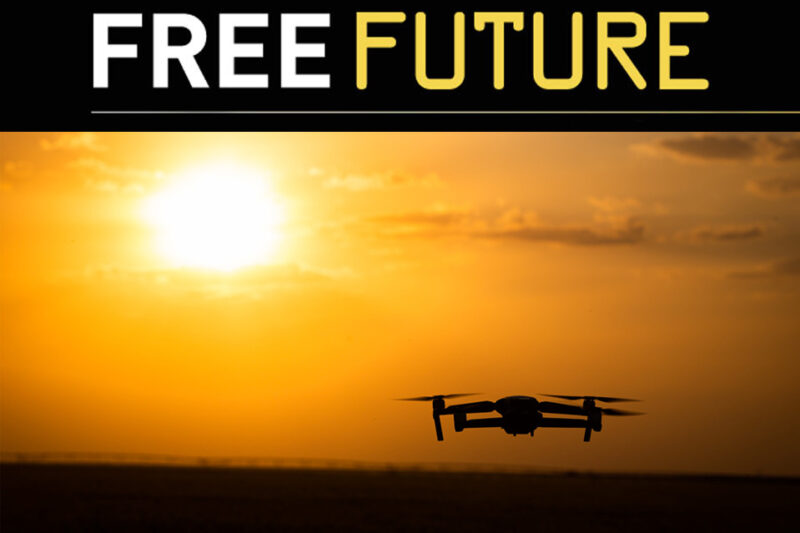
We’re seeing a rapid expansion of what are known as “Drones as first responder” (DFR) police drone programs — under which police send a drone to your house or other location when you dial 911. From the start, one of the big civil liberties questions about these programs is whether they’ll morph into routine aerial patrols over communities. We discussed DFR programs in this 2023 white paper, in which we explain why we’re deeply skeptical of them. But already, drones are being used for far more than responding to particular calls for service.
Police departments around the country know that high-tech aerial surveillance is a touchy issue — especially now that an anti-Flock social movement has emerged. So they’ve been striving to emphasize to communities that their use of the technology will be confined to specific incidents and calls for service, and will not, in fact, be used for patrols or other random surveillance such as hunch-chasing, fishing expeditions, or curiosity-driven overflights.
The CEO of Skydio, the leading US drone manufacturer, recently argued that a drone is
extremely narrow and precise. It’s not blanketing a city in cameras that are passively collecting. It’s responding where you know there’s an emergency and providing very narrow intelligence just in that scenario to drive better outcomes.
That’s just not accurate. There are several problems with the claim that police drone use is “narrow and precise.”
First, these promises that drones will only be used to respond to calls for service typically only refer to the specific context of the DFR programs themselves. Many departments have DFR drones based in docks on building rooftops, for example, but also have drones that are launched out of the trunk of a police cruiser. Outside of their DFR programs, and sometimes within them, many departments use the technology to hover over protests, rallies, and other sensitive gatherings of people exercising their First Amendment rights to assembly and free expression. Such “event monitoring” is one of the leading use cases for police drones. (I discussed event monitoring in a 2024 white paper.)
Other uses of drones are also emerging that send the craft flying around communities for various reasons; under one New Jersey police department’s program, for example, the police will fly drones to check on your home while you’re on vacation. Maybe that will prove valuable, or maybe not, but it’s just that many more police drones roaming around a community, and a step closer to routine drone patrols.
Second, there are a number of police departments around the nation that ARE using drones for patrols or other suspicionless surveillance. Examples include:
- The NYPD is carrying out proactive drone patrols. “I want the drones to give us an aerial view of exactly what’s going on, and just looking for anything out of the ordinary,” one top department official said.
- Beverly Hills, CA uses drones to patrol the city, according to news reporting by Bloomberg and the LA Times. Officials told the Times that drones have been used to “fly in pattern” across Beverly Hills looking for suspicious activity. One official stated outright that the goal was “ubiquitous coverage.”
- Oklahoma City police deployed DFR drones at the Oklahoma State Fair to not only “quickly respond to calls for service,” but also to “provide additional overwatch for the safety of the attendees,” according to a Skydio page on the deployment (emphasis added).
Are these police departments outliers within the law enforcement profession — or are they just ahead? Are they just further along the mission creep curve than the departments that swear they’ll never do suspicionless patrols?
The United States is a big country, with an estimated 16,000-18,000 police agencies, and we don’t know how often drones are already being used in this way. In San Francisco, a number of the flights that are visible in leaked drone footage look pretty aimless and patrol-like, even if strictly speaking they may have been in response to calls for service.
With some other deployments, police departments present their drone deployments as DFR programs under which the aircraft are only launched in response to calls, but hint that they might be used more broadly. The Miami Beach police chief publicized his department’s acquisition of drones in 2025 as a message to spring breakers. “Hey, come down here, have a good time, but we’re gonna give you a reality check,” he told a local television station, which observed, “The reality check is that police are ready and watching.” An Oceanside, CA police official told a reporter of the city’s 15 drones on July Fourth, “I’m not saying that all of them are gonna be up at the same time, but I’m also not gonna say that they’re not.”
There’s also the fact that where DFR programs require purpose logging (an oversight mechanism of dubious value), many flights do not contain meaningful descriptions of their purposes. A Wired investigation into Chula Vista, CA drone program, for example, found that about one in 10 drone flights lacked any stated purpose. An unknown number of such flights may be for suspicionless fishing-expedition flights.
Finally, in the private sector we’re already seeing not only patrols via drone, but even autonomous patrols that don’t require close attention from human operators. This makes it possible to cheaply scale up flights without needing more employees. I’m sure a lot of police departments would love to be able to do the same — and a lot of drone vendors would also love for them to be able to.
We have some questions, chief
Given the existence of police departments that are now conducting or may have the door open to suspicionless drone flights, what does that mean for the promises that your police department may be making about never going down that road?
First, it constitutes evidence that the slope is slippery when it comes to police drone deployments. I’ve spoken to many police officials who are enthusiastic about using drones, and many or most of them seem genuinely focused on specific uses and unlikely to be harboring secret plans to turn the technology toward broad surveillance. But it seems clear the law enforcement profession as a whole often embraces mass surveillance technologies when it makes their life easier, from license plate readers to surveillance camera networks. And as we have seen there are already some prominent US police agencies moving in that direction.
If police officials, vendors, or others in your community are pushing to launch, continue, or expand a police drones program (whether a DFR or other program), they should be asked about this by elected officials or members of the public. Questions might include:
- Do you anticipate that eventually drones will be used not only to respond to calls for service, but also for routine patrols?
- If you don’t anticipate using drones for patrols, would you have any problem with, or actively support, the passage of a law banning such deployments?
- There are some cities that are using drones for patrol. Do you condemn those departments’ use of drones for that purpose?
- Would you say that the police profession as a whole is likely to embrace the use of drones for patrol, given that the NYPD has? If it does, why should we think you will be an outlier?
- Do you support the use of drones over protests, marches, or other gatherings of people?
- Do you acknowledge that such flights can be intimidating for people and affect their First Amendment rights to assembly and self-expression?
- Would you support a law that imposes restrictions on the deployment of drones over gatherings?
If your local police are speaking in earnest about their lack of desire to use drones for widespread surveillance, then they shouldn’t have any issues with banning such uses. Indeed, they should actively support them to increase trust for narrower drone deployments, such as search and rescue, that their community might support.
Related Issues
Related Content
-
Washington, D.C.Oct 2026
Free Speech
Privacy & Technology
In Re Appeal From Order Denying Motion To Quash Grand Jury Subpoena In Case No. 1:26-gj-00022-jeb. Explore Case.In re Appeal From Order Denying Motion to Quash Grand Jury Subpoena in Case No. 1:26-GJ-00022-JEB
-
News & CommentaryOct 2026

Privacy & Technology
Criminal Law Reform
Police Are Increasingly Pulling People Over Because Ai Deems Their Driving Patterns “suspicious”. Explore News & Commentary.Police Are Increasingly Pulling People Over Because AI Deems Their Driving Patterns “Suspicious”
Anybody is susceptible to being stopped, searched, or worse; AI makes new forms of abuse possible -
News & CommentaryOct 2026
Privacy & Technology
Your Questions Answered: How Data Centers Erode Civil Rights And Civil Liberties. Explore News & Commentary.Your Questions Answered: How Data Centers Erode Civil Rights and Civil Liberties
ACLU experts break down how data centers negatively impact communities, violate civil liberties, and how we can respond. -
News & CommentaryOct 2026

Privacy & Technology
How Technologies Move From Empowering To Imprisoning. Explore News & Commentary.How Technologies Move From Empowering to Imprisoning
Transportation expert’s warning on self-driving cars captures the way technologies move from empowering options to disempowering requirements