ACLU Responds to Trump’s Anti-Voter Executive Order

WASHINGTON, D.C. — The American Civil Liberties Union condemns President Donald Trump's executive order signed today, which aims to upend U.S. elections and disenfranchise millions of eligible voters. This directive represents a significant overreach of executive power and poses a direct threat to the fundamental right to vote.
The executive order directs the Election Assistance Commission to change the national mail voter registration form to require documentary proof of citizenship, such as a passport, to register to vote. The order also attempts to force states to enact documentary proof of citizenship requirements and to stop counting absentee and mail-in ballots received after Election Day in accordance with state law by threatening to withhold federal funding.
Sophia Lin Lakin, the director of the ACLU’s Voting Rights Project, released the following response:
“President Trump's executive order attempting to require documentary proof of citizenship for voter registration and restrict the acceptance of mail-in ballots received after Election Day, among other measures, is a blatant overreach that threatens to disenfranchise tens of millions of eligible voters. This measure will no doubt disproportionately impact historically-excluded communities, including voters of color, naturalized citizens, people with disabilities, and the elderly, by pushing unnecessary barriers to the fundamental right to vote. We deserve better than elected officials weaponizing xenophobia and the myth of voter fraud to jeopardize our rights. We will do everything in our power to stop this unconstitutional attack on the right to vote to ensure that every eligible American can participate in our democracy. We will see President Trump in court.”

Voting Rights
League of Women Voters Education Fund v. Trump
Voting Rights
League of Women Voters Education Fund v. Trump
Related Issues
Related Content
-
OhioFeb 2026
Voting Rights
League Of Women Voters Of Ohio V. Larose. Explore Case.League of Women Voters of Ohio v. LaRose
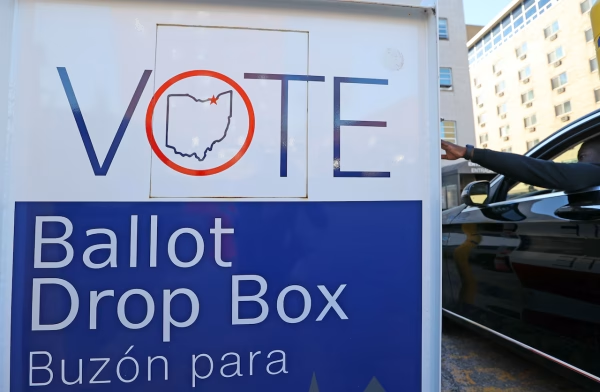
Voting-rights and civil-rights organizations filed a federal lawsuit challenging a new Ohio law that threatens to wrongly strip eligible citizens—particularly naturalized citizens—of their right to vote. The case arises from Ohio Senate Bill 293 (SB 293), a law that mandates aggressive, automated purges of Ohio’s voter rolls based on flawed citizenship data. Under SB 293, state officials are required to conduct frequent database checks and cancel voter registrations for people flagged as “noncitizens”—often without advance notice or a meaningful opportunity to correct mistakes. Plaintiffs brought this case to stop a system that places thousands of eligible voters at risk of disenfranchisement and undermines fundamental protections guaranteed by federal law and the U.S. Constitution. -
Press ReleaseFeb 2026

Voting Rights
Nonpartisan Group Urges Court To Protect Georgians’ Private Voter Data Seized In Fbi Raid. Explore Press Release.Nonpartisan Group Urges Court to Protect Georgians’ Private Voter Data Seized in FBI Raid
ATLANTA — Georgia First, a nonpartisan organization dedicated to protecting voter privacy, safeguarding the integrity of election records, and defending the public’s right of access to judicial proceedings, filed an amicus brief supporting Fulton County’s emergency petition seeking the return of sensitive voter data obtained during a recent FBI raid. They are represented by the American Civil Liberties Union, the ACLU of Georgia, and Garland, Samuel & Loeb, P.C. The filing urges the court to order the return of unlawfully obtained voter data or, if not returned, to issue a protective order ensuring some security and protection of voters’ confidential information. The data was seized by the federal government with a warrant obtained in the latest investigation of the 2020 election–an election that has been contested and litigated for years, with no credible evidence of fraud ever found. The data at issue reportedly includes full, unredacted voter files containing names, addresses, dates of birth, driver’s license numbers, social security numbers, and other sensitive personal identifiers. “Georgia First knows that the principle of secure, free, and fair elections demands our state and nation responsibly guard election integrity, which is built upon safety, security, and accessibility,” said Natalie Crawford, Founder & Executive Director of Georgia First. “It is with these values top of mind that Georgia First files this brief asking for Court action imperative to preserving public confidence in the elections process. People must always come before politics — throughout Georgia and the United States.” “Voters provide this information with the expectation that it will be used solely to facilitate election administration — not taken without clear reasoning or used as a political pawn,” said Cory Isaacson, legal director at the ACLU of Georgia. “Actions like this risk undermining public trust and chilling civic participation.” “Protecting voter privacy is essential to maintaining confidence in our democratic process,” said Theresa J. Lee, senior staff attorney with the ACLU Voting Rights Project. “Unchecked access to sensitive voter data exposes them to identity theft, security breaches, and more. We cannot allow this federal overreach to continue.” The brief also notes that federal and state privacy laws limit the sharing of sensitive voter details without a clear statutory basis. Collecting such information without defined boundaries or publicly articulated protections erodes confidence in election systems at a time when public trust is already strained. Read the brief here: https://assets.aclu.org/live/uploads/2026/02/Fulton-County-Georgia-First-Amicus-Filed-1.pdf -
GeorgiaFeb 2026

Voting Rights
Pitts V. United States (amicus). Explore Case.Pitts v. United States (Amicus)
The FBI raided Fulton County, Georgia, seizing ballots and other records from the 2020 election. This unprecedented seizure is a continuation of yearslong efforts to challenge Georgia's 2020 election results, now aided by federal law enforcement. Fulton County is fighting back, suing for the return of the records. -
Press ReleaseFeb 2026
Voting Rights
Aclu Condemns House Passage Of Save America Act As Dangerous Assault On Democracy. Explore Press Release.ACLU Condemns House Passage of SAVE America Act as Dangerous Assault on Democracy
WASHINGTON — The U.S. House of Representatives has passed the so-called SAVE America Act, which would impose new burdensome requirements related to voter registration processes and expand federal involvement in state election administration. The bill now moves to the U.S. Senate for consideration. “The SAVE America Act is another thinly veiled attempt to interfere with our elections,” said Xavier Persad, senior policy counsel for ACLU’s National Political Advocacy Department. “There is no evidence of widespread voter fraud that justifies imposing burdensome show-your-papers requirements on every eligible voter. Laws like this have historically resulted in many eligible citizens being delayed or denied access to the ballot due to paperwork issues, database mismatches, or bureaucratic error. What we are seeing from elected officials: seizing sensitive voter data, calls to ‘nationalize’ voting, using violent federal agent presence as a bargaining chip — none of this is normal and we must protect our voices and our ability to hold these officials accountable. These attacks on the freedom to vote and local election administration are occurring while federal immigration agents continue to brutalize our communities, kidnap our neighbors, and violate constitutional protections that are foundational to our democracy, including the right to protest and freedom of the press. The SAVE America Act and similar efforts are attempts to distract from these federal abuses of power while silencing voters who seek to hold this administration accountable at the ballot box. We urge the Senate to reject this bill and all attempts to undermine our elections.” The SAVE America Act, like the Make Elections Great Again (MEGA) Act, is another more extreme attempt to enact the dangerous provisions of the SAVE Act. This legislation would require passports or birth certificates just to register to vote or update voter registration information — documents that an estimated 21 million eligible voters don’t have ready access to. As many as 69 million women who have changed their name due to marriage would face additional hurdles. The SAVE America Act would also impose extremely restrictive photo ID requirements to vote. Voters with low incomes, naturalized citizens, voters of color, rural voters, older voters, young voters, and transgender voters would be disproportionately impacted by these restrictions due to financial constraints, mismatched paperwork, and other obstacles. Moreover, the SAVE America Act would force states to engage in faulty voter roll purges and turn over Americans’ private, sensitive voter data to the U.S. Department of Homeland Security. Previously, Kansas enacted a documentary proof-of-citizenship law which required people to prove their citizenship to register to vote. It blocked more than 30,000 eligible voters from registering to vote, and was later struck down for violating the National Voter Registration Act and U.S. Constitution. The vote comes amid ongoing legal disputes between the federal government and several states concerning access to voter records and election data. In recent months, the Trump Administration has sought expanded access to sensitive voter information, without explanation or plans to protect it, and has raided an election center in Fulton County, Georgia in an attempt to further push false claims about the 2020 election results.