Research & Publications
Access in-depth resources and analysis published by the ACLU regarding our most pressing civil liberties issues.
ACLU 2025 Annual Report
Our 2025 annual report details how the ACLU’s network of 2,175 staff and 7 million activists and members worked around the clock this year to protect free speech, immigrants’ rights, LGBTQ equality, and much more from the Trump administration’s unconstitutional agenda. To date, the ACLU has already taken over 200 legal actions against the Trump administration. Alongside lists of the ACLU’s key wins and efforts in 2025, the report tells the stories of ACLU advocates, clients, and staff who are on the front lines of this fight.

All Publications
Search will open in a new tab using DuckDuckGo
The Dawn of Robot Surveillance
Imagine a surveillance camera in a typical convenience store in the 1980s. That camera was big and expensive, and connected by a wire running through the wall to a VCR sitting in a back room. There have been significant advances in camera technology in the ensuing decades — in resolution, digitization, storage, and wireless transmission — and cameras have become cheaper and far more prevalent. Still, for all those advances, the social implications of being recorded have not changed: when we walk into a store, we generally expect that the presence of cameras won’t affect us. We expect that our movements will be recorded, and we might feel self-conscious if we notice a camera, especially if we’re doing anything that we feel might attract attention. But unless something dramatic occurs, we generally understand that the videos in which we appear are unlikely to be scrutinized or monitored. All that is about to change.
Today’s capture-and-store video systems are starting to be augmented with active monitoring technology known variously as “video analytics,” “intelligent video analytics,” or “video content analysis.” The goal of this technology is to allow computers not just to record but also to understand the objects and actions that a camera is capturing. This can be used to alert the authorities when something or someone deemed “suspicious” is detected, or to collect detailed information about video subjects for security or marketing purposes. Behind all the dumb video camera “eyes” that record us will increasingly lie ever-smarter “brains” that will be monitoring us. As we will see, technologists are working on teaching computers to do that monitoring in remarkable ways across a broad variety of dimensions.

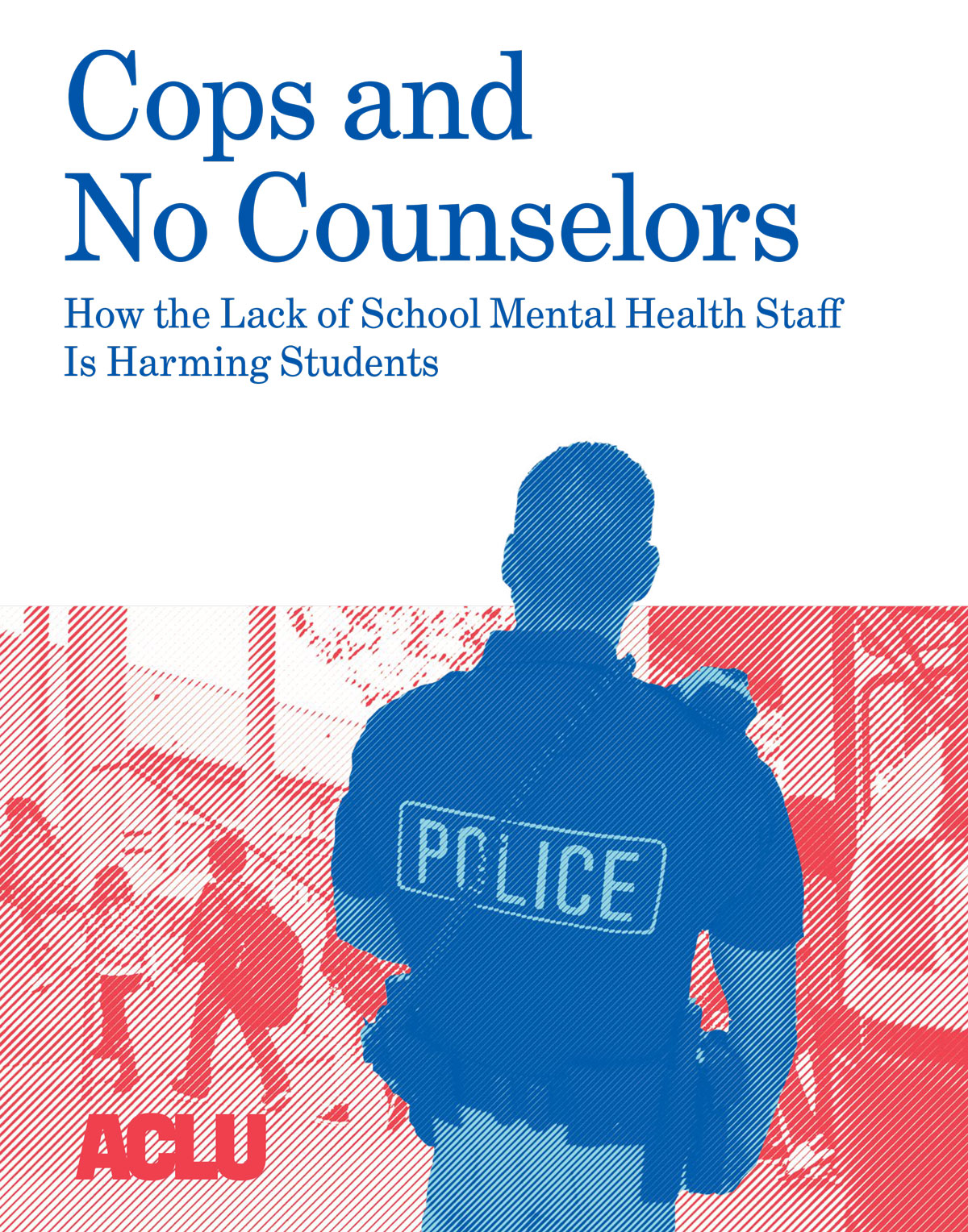
Cops and No Counselors
The U.S. Department of Education recently required every public school to report the number of social workers, nurses, and psychologists employed for the first time in history. Data about school counselors had been required previously, but this report provides the first state-level student-to-staff ratio comparison for these other school-based mental health personnel, along with school counselors. It reviews state-level student-to-school-based mental health personnel ratios as well as data concerning law enforcement in schools. The report also reviews school arrests and referrals to law enforcement data, with particular attention to disparities by race and disability status. A key finding of the report is that schools are under-resourced and students are overcriminalized.
"You Miss So Much When You're Gone"
Mothers in jail are being torn from their families and losing contact with their children even before they have been convicted of a crime.
A report by the ACLU and Human Rights Watch, “‘You Miss So Much When You’re Gone’: The Lasting Harm of Jailing Mothers Before Trial in Oklahoma,” finds that jailing mothers even for short periods of time can result in overwhelming debt and loss of child custody. Based on more than 160 interviews with jailed and formerly jailed mothers, substitute caregivers, children, attorneys, service providers, child welfare employees, and advocates, this report documents the harms experienced by women with minor children jailed pretrial in Oklahoma – which incarcerates more women per capita than any other state.
An estimated 80 percent of women in jails in the United States are mothers with minor children and are more likely to be single parents or provide primary care to their children than jailed fathers. When moms are incarcerated, their children are more likely to end up in foster care.
When a mother is jailed even for a short time, the entire family is punished. Jail stays can snowball into long-term family separation as moms struggle to overcome obstacles to regain custody of their children and get back on their feet.
Women are the fastest growing correctional population nationwide. Local jails are a major driver of that growth. The number of women in jail has increased from approximately 8,000 in 1970 to 110,000 in 2014. And over the past 15 years, 99 percent of jail growth has been a product of pretrial incarceration. Women may have more trouble affording bail than men because of higher poverty levels and the gender pay gap.
Jails, intended to house people for much shorter periods of time, are often ill-equipped to facilitate family visits. Jail visitation policies in Oklahoma often bar children from in-person visitation or have eliminated in-person visitation altogether. Phone or video visitation may be cost-prohibitive and impractical for communicating with young children. Mothers described losing contact with their children for months and the stress of not knowing their children’s whereabouts while they were in jail. The anxiety is compounded in cases where authorities have failed to ensure that jailed parents are transported to family and juvenile court proceedings, and receive regular case updates. These failures can effectively prevent parents’ full participation in key child custody decisions.
Moms know that the cost of staying in jail and fighting charges could be losing custody of their children. Every day they are jailed, they are missing out on their children’s lives, and many have limited means of remaining in contact. This creates enormous pressure to plead guilty, even if they are wrongly charged.
Jailed and formerly jailed mothers told the ACLU and Human Rights Watch they accepted guilty pleas because they had childcare responsibilities, had limited contact with their children, and were not involved in custody decisions. For example, April, a 30-year-old mother of three, said that she pleaded guilty to a robbery, against the advice of counsel, in exchange for a 10-year suspended sentence. April said she could have fought the charge, but she decided she had to get back to her children: “I wasn’t thinking ‘Oh I am going to be a felon [for] the rest of my life,’ I was just thinking I have to take care of my kids.” She said she had no contact with her children while in jail and she was not notified by family court that the paternal grandparents of her eldest child were seeking custody. April told us that she did not find out that her child was now in the grandparents’ custody until after she was released from jail.
The struggle doesn’t end with release from jail. Mothers are often presented with exorbitant bills for their jail stay in addition to other fines and fees, making it harder for them to get back on their feet and establish the stability they need to regain custody of their children. Oklahoma imposes significant costs on criminal defendants and upon conviction, often including a bill for time spent in jail, any medical expenses incurred during that time, fines, fees, and court costs, supervision fees and other costs associated with probation or rehabilitation, and significant costs to reinstate drivers’ licenses if their license is suspended or revoked. When attempting to regain custody of children in the state’s care, costs can also accumulate for psychological evaluations, mandated drug testing, and child support, placing poor parents at a significant disadvantage when attempting to reunite with their children. Many told us the obstacles seemed insurmountable.
The ACLU and Human Rights Watch urge Oklahoma and other states to require the consideration of a defendant’s caretaker status when making determinations about bail and sentencing, expand alternatives to incarceration, facilitate the active involvement of incarcerated parents in their children’s lives and proceedings related to child custody, and substantially curb the imposition of fees and costs, which can impede reentry and parent-child reunification.
Author: Jasmine Sankofa (@juSankofa)
Press Coverage: Rewire News Group | Tulsa World
Article/Blogs Written By Author: “Mothers Should Not Be Jailed and Separated From Their Kids Before Trial” – ACLU | “The Legal System Has Failed Black Girls, Women, and Non-Binary Survivors of Violence” – ACLU
Related Advocacy/Litigation: Brown v. Lexington County, et al | Bill Protecting Parents in Prison, and Their Children and Families, Passess Legislature
Death, Damage, and Failure
The U.S. has turned away from addressing the complex causes of immigration and smuggling, and a careful consideration of the most effective ways to respond to these issues, and instead has focused myopically on enforcement and militarizing our borders. Building walls along the southwest border has become a centerpiece of this trend. Like the overemphasis on enforcement, the border wall project is not grounded in facts. But existing border walls blight border communities, tear apart delicate border ecosystems, and redirect crossings into the most remote and treacherous areas where thousands of men, women, and children have lost their lives attempting to enter the United States in search of safety or economic opportunity. In this report, we analyze the rationale behind border barriers, discuss the effectiveness of border walls in regards to unauthorized migration, smuggling, and national security, and illustrate the wide-ranging damages that existing walls have inflicted upon border communities, the environment, and the lives of border crossers.
11 Million Days Lost: Race, Discipline, And Safety at U.S. Public Schools (Part 1)
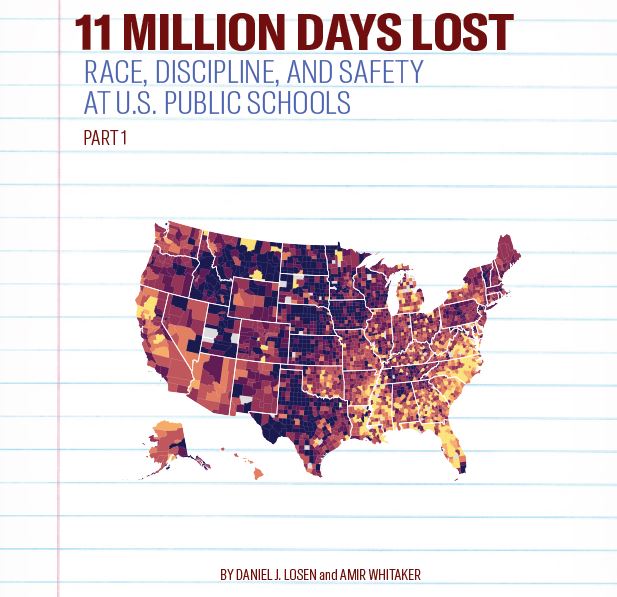
There are more than 96,000 public schools in America. The U.S. Department of Education recently released data that was collected from all of them. The data, based on the 2015-2016 school year, reveals the extent of police presence in schools, the lack of basic services, and the growing racial disparities in public school systems serving 50 million students. In many communities, all of these conditions are worsening.
The ACLU partnered with the UCLA Civil Rights Project to publish a series of reports and data tools to enhance the public’s understanding of the Civil Rights Data Collection (CRDC). Some data are being reported publicly for the first time, including the number of days lost to suspension; the number of police officers in stationed in schools; and the number of school shootings reported nationwide.
A careful examination of this data also calls into question how the Department of Education under Secretary Betsy DeVos is interpreting it. In a recent publication highlighting the data on “school climate and safety,” the administration reported on the number of school shootings without checking for errors, potentially inflating the number of school shootings by the hundreds. Instead of proceeding with care, the administration is now using the flawed data on school shootings to emphasize a need for more school discipline — which has turned schools into militarized places that deprive students of color of an equal education, as previously reported by earlier administrations.
Here are four big takeaways revealed in our series of reports.
ACLU Magazine
Published twice a year, ACLU Magazine shares updates on the ACLU’s critical litigation and advocacy work across the country and tells the stories of the activists, attorneys, and clients at the heart of each case and campaign. To receive ACLU Magazine by mail, become a monthly donor today.