Your Questions Answered: How Data Centers Erode Civil Rights and Civil Liberties
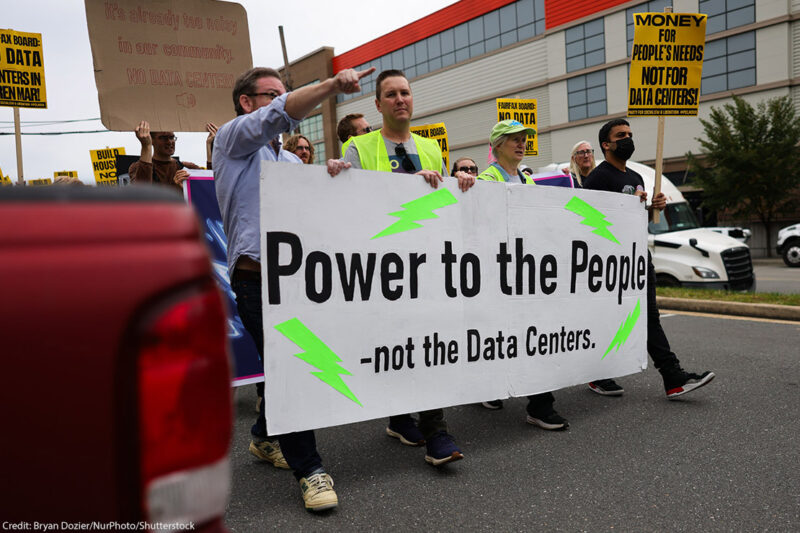
Across the nation, from cities like Minneapolis and Tuscon to small towns like Peculiar, Missouri, people have made it clear that they don’t want data centers in their communities, often citing environmental impacts. What we don’t often hear about is how data center projects can erode our core civil rights and civil liberties.
Hyperscale data centers are the physical foundation of the digital world and artificial intelligence. They can extend for miles, housing thousands of networked servers that consume massive amounts of electricity and fresh water. As the race to build up AI infrastructure accelerates, so does the risk of severe environmental, economic, and other harms to Indigenous communities and communities of color. Tech companies routinely use secret non-disclosure agreements and backroom municipal deals to force these facilities into communities without their consent, undermining democratic accountability. Like any major infrastructure project, data center projects must adhere to a fair and transparent process with genuine community accountability.

Privacy & Technology
Privacy & Technology
In our latest “Your Questions Answered,” we broke down how data centers harm our civil rights and civil liberties and how we can push for policies that promote transparency and equity around data center projects.
How do data centers impact democratic values?
Data center projects can undermine democratic accountability. They are frequently negotiated in secret. A community may find out about a top-secret economic development project, but they don’t get any further information. Then suddenly, there’s a massive data center site in town affecting people’s day-to-day lives.
Data center developers regularly demand that government officials sign non-disclosure agreements (NDAs). When government officials cave to those demands and sign NDAs, they are unable to share information about the project. That means that people are unable to hold their elected officials accountable as officials negotiate agreements that impact the community’s environment, health, taxes, property values, utilities, and more.
How do data centers impact communities of color and Indigenous communities?
The negative effects of data centers can disproportionately harm communities of color and Indigenous communities. Neighborhoods closest to data centers, or power plants that support data centers, are exposed to high levels of air and noise pollution. These neighborhoods are disproportionately communities of color. For example, the NAACP has sued the company xAI for evading environmental standards for its Colossus data centers in Memphis, polluting nearby historically Black neighborhoods.
Similarly, Indigenous communities not only are exposed to health hazards, but also have faced strains on water, electricity, and other utilities. Data centers frequently target rural areas and land near reservations to secure cheap acreage and direct access to existing power grids and waterways. This can deplete local watersheds protected under tribal law and monopolize local electrical capacity.
How do data center projects impact First Amendment rights?
Governments have tried to limit people’s right to protest data centers, including through law enforcement crackdowns. Many states have designated data centers as critical infrastructure, giving prosecutors the ability to pursue domestic terrorism charges against protestors. Furthermore, federal law enforcement has encouraged crackdowns on “anti-tech extremism,” improperly singling out protestors because of their viewpoints. People need the ability to voice their concerns about data center projects without facing retribution.
How do data centers impact privacy?
Data center providers use advanced surveillance technologies that erode our privacy rights. This includes AI surveillance like thermal cameras and facial recognition tools that use 3D facial analysis and techniques like facial vein detection, which can even be used to tell twins apart. Companies also use drones and robot dogs to patrol data centers and their surrounding areas, which means they can closely surveil neighborhoods near data centers and potentially turn over the information and footage they have collected to law enforcement.
What should we do about data centers in our communities?
First, because government decisions on data centers can affect our civil rights and civil liberties, we have a right to know what is at stake and make our voices heard. We need policies that promote transparency and equity in the siting, construction, and operation of data centers. To start, we need to ban the use of NDAs by government officials to negotiate economic development projects. Communities must be empowered to decide if and how data centers are constructed and operated through public hearings and other public comment opportunities. These should be opportunities to raise concerns like racial inequity and surveillance. And protests cannot be shut down based on protestors’ viewpoints or unfounded claims of protesters causing harm.
Second, governments must block data center projects that could disproportionately harm communities of color and Indigenous communities. Any data center proposal must include a comprehensive assessment of potential impacts and the populations that would be impacted, as identified through census data. As part of the review process, the assessment must be publicly available for input and the government must determine whether the data center project proposal could disproportionately impact communities of color or indigenous communities.
Related Issues
Related Content
-
News & CommentaryOct 2026

Privacy & Technology
How Technologies Move From Empowering To Imprisoning. Explore News & Commentary.How Technologies Move From Empowering to Imprisoning
Transportation expert’s warning on self-driving cars captures the way technologies move from empowering options to disempowering requirements -
News & CommentaryOct 2026
Privacy & Technology
How Technologies Move From Empowering To Imprisoning. Explore News & Commentary.How Technologies Move From Empowering to Imprisoning
Transportation expert’s warning on self-driving cars captures the way technologies like Digital IDs, Face recognition, AI, and digital payments move from empowering options to disempowering requirements -
News & CommentaryOct 2026

Privacy & Technology
$100 Million Ice “intelligence” Program Is A Domestic Secret Police Agency In The Making. Explore News & Commentary.$100 Million ICE “Intelligence” Program is a Domestic Secret Police Agency in the Making
Administration that has ordered agencies to target activists and nonprofits would hire “intelligence” agents within ICE to identify “threats” and investigate “relationships” -
News & CommentaryOct 2026

Privacy & Technology
Are Police In Your Community Laundering License Plate Data Through Federal Drug Programs Into A Secretive Central Database?. Explore News & Commentary.Are Police in Your Community Laundering License Plate Data Through Federal Drug Programs Into a Secretive Central Database?
New report suggests this is a question local communities fighting against mass surveillance should be asking their elected officials