Drones For People Not Just Police and Corporations
Subscribe to the Free Future Newsletter
Free Future home
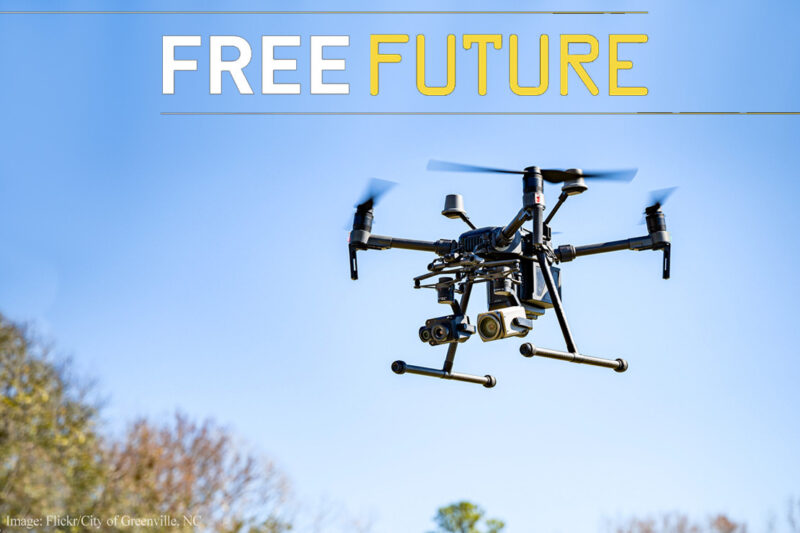
The Trump Administration’s lawless deportation campaign has revealed an administration that wants to empower government to watch and record ordinary people, but not allow people to record the government — and that stance, which has things exactly backwards in a democracy, has extended to drone flights. There have been numerous reports of drone use by immigration agencies to record and intimidate protesters, observers, and others, combined with efforts to block journalists and ordinary people from using the technology to monitor the government.
That pattern is part of an ongoing trend of law enforcement seeking broad powers to ban and interfere with drone flights. But it’s also part of an even larger and more dismaying trend: the construction of a regulatory regime that renders drones primarily usable by law enforcement, government, and big companies.
We’re in danger of creating a future in which our skies are dominated by surveillance and corporate drones, aerial imagery is under their control and their control only, and people can’t counter visual or other narratives with their own drone flights. A future where ordinary people mainly experience drones as a negative force in their lives — where they are constantly conscious of intimidating police drones hovering overhead, and annoyed by corporate delivery flights over their homes that they can’t do anything about. Where, when they try to fly a drone themselves, they find it hard to buy one, are constantly hemmed in by restrictions, are forced to give way to companies that are given priority, and law enforcement threatens $10,000 fines and worse when they deem people’s flights a “threat.”
Today we’ve published an ACLU white paper on this trend. We argue that under current trends, drones are increasingly looking like a technology that ordinary people will be:
- Unable to fly. Broad counter-drone authorities, based on fears about the potential security threat that some drones could pose, are being pushed without checks and balances to preserve the vast majority of legitimate and safe individual uses.
- Unable to buy. An unexpectedly broad Trump Administration ban on foreign drones, combined with market and technology conditions, threaten to reduce drones to an expensive specialty item mainly designed for police and the military and out of reach of ordinary people.
- Forced to accept in their communities. While ordinary people may find themselves unable to deploy drones without arbitrary interference and punishment, they may at the same time be unable to have a say in police and corporate drone operations over their communities, despite any objections they may have to such flights.
- Subject to surveillance and intimidation by. Similarly, the refusal of the FAA and others to enact protections for privacy in the face of this powerful new surveillance technology may subject ordinary people to increasingly routine aerial monitoring of their lives.
- Unable to identify. Even as they are subject to aerial surveillance by the government and companies, people will themselves be blocked from accessing useful information about the drones flying overhead.
In the 9-page paper, we take a closer look at each of these areas and point to policy solutions for each.
Related Issues
Related Content
-
News & CommentaryOct 2026
Privacy & Technology
Your Questions Answered: How Data Centers Erode Civil Rights And Civil Liberties. Explore News & Commentary.Your Questions Answered: How Data Centers Erode Civil Rights and Civil Liberties
ACLU experts break down how data centers negatively impact communities, violate civil liberties, and how we can respond. -
News & CommentaryOct 2026

Privacy & Technology
How Technologies Move From Empowering To Imprisoning. Explore News & Commentary.How Technologies Move From Empowering to Imprisoning
Transportation expert’s warning on self-driving cars captures the way technologies move from empowering options to disempowering requirements -
News & CommentaryOct 2026
Privacy & Technology
How Technologies Move From Empowering To Imprisoning. Explore News & Commentary.How Technologies Move From Empowering to Imprisoning
Transportation expert’s warning on self-driving cars captures the way technologies like Digital IDs, Face recognition, AI, and digital payments move from empowering options to disempowering requirements -
News & CommentaryOct 2026

Privacy & Technology
$100 Million Ice “intelligence” Program Is A Domestic Secret Police Agency In The Making. Explore News & Commentary.$100 Million ICE “Intelligence” Program is a Domestic Secret Police Agency in the Making
Administration that has ordered agencies to target activists and nonprofits would hire “intelligence” agents within ICE to identify “threats” and investigate “relationships”